HVAC Is Becoming Climate Infrastructure
The industry is being pulled into the centre of the climate conversation
Heating the UK’s 28 million homes accounted for 18% of all UK greenhouse gas emissions in 2021. The government has also set an ambition to grow heat pump supply chain capacity to at least 600,000 installations per year by 2028.
That gives HVAC a very different strategic role.
This is not just about installing more equipment. It is about managing a larger, more complex and more regulated estate of heating, cooling and refrigeration assets over time.
At the same time, Great Britain is continuing to phase down HFCs, including mixtures, by 79% by 2030 compared with average use between 2009 and 2012. For the HVAC and refrigeration sector, that means refrigerant choice, refrigerant movement, asset history and CO₂e visibility are becoming operational concerns, not just technical details.
This is the part of the transition that is often missed.
A lower-carbon HVAC future does not only require new equipment.
It requires better operational information.
Cooling demand is changing the role of HVAC
The UK has historically thought of cooling as optional. That assumption is weakening.
Warmer summers, overheating buildings, changing working patterns and higher comfort expectations are all increasing the importance of cooling. For facilities managers, landlords, healthcare estates, education settings, retail environments and commercial buildings, cooling is becoming a resilience issue.
That creates a complicated tension.
More cooling can support health, comfort and productivity. But if it is poorly specified, poorly maintained or poorly monitored, it can increase energy demand and environmental impact.
This is why the sector needs to move beyond a simple “install and maintain” mindset.
The future of HVAC is not just more assets.
It is more accountable assets.
Every system has a history. Every refrigerant movement matters. Every leak check has a date, a result and a follow-up responsibility. Every engineer visit adds to the evidence trail. Every customer request for compliance information depends on whether the underlying data is clean enough to trust.
The businesses that manage this well will not be the ones with the most paperwork.
They will be the ones with the clearest operational picture.
F-Gas is a data challenge as much as a refrigerant challenge
F-Gas regulation is often discussed through the lens of phase down, bans and lower-GWP alternatives.
Those are important. But for day-to-day HVAC operations, the data burden is just as significant.
F-Gas leak check frequency depends on the amount of gas in the equipment and the global warming potential of that gas. Equipment containing 5 to less than 50 tonnes CO₂e must generally be checked at least every 12 months. Equipment containing 50 to less than 500 tonnes CO₂e must generally be checked at least every six months. Higher thresholds can require more frequent checks or automatic leak detection.
That means teams need to know more than whether an asset exists.
They need to know what refrigerant it contains, how much is installed, what that means in CO₂e, when it was last checked, what happened during the visit, whether gas was added or removed, whether a repair was completed and whether the follow-up evidence is complete.
Records also need to be retained. For equipment containing F-Gas equivalent to 5 tonnes CO₂e or more, records must be kept for five years, including the quantity and type of gas installed, gas added during maintenance, leak check dates and results, recovery and disposal activity, and details of companies used to install, service or decommission equipment.
This is not light-touch administration.
It is a structured evidence requirement.
And that creates a problem for any business still managing HVAC compliance through disconnected systems, manual processes or engineer memory.
The hidden issue is not regulation. It is operational ambiguity.
Most HVAC businesses understand that regulation matters.
The harder issue is operational ambiguity.
Who owns the asset record?
Where is the current refrigerant data?
Can the office team see what happened on site?
Can the engineer access the previous history before attending?
Can the compliance manager prove what changed and when?
Can the customer receive a clean answer without someone rebuilding the evidence manually?
When the answer depends on checking several spreadsheets, job notes, paper sheets, inboxes and local folders, the business has a problem that is bigger than admin.
It has an ownership problem.
Because when information lives in too many places, responsibility becomes difficult to prove.
That does not mean teams are careless. In most cases, the opposite is true. HVAC and refrigeration teams are often working hard to manage complex obligations with systems that were never designed for the level of evidence now expected.
The risk is not a lack of effort.
The risk is that the operating model has not caught up with the regulatory and environmental importance of the work.
Skills pressure makes poor information more expensive
The HVAC industry also has to think carefully about labour capacity.
When skilled engineers are in short supply, their time becomes even more valuable. Every unnecessary phone call, duplicate form, unclear asset record or missing job history takes technical capacity away from work that actually requires technical judgement.
This matters because the sector is being asked to expand and improve at the same time.
More heat pumps.
More cooling systems.
More regulated refrigerant activity.
More compliance evidence.
More customer expectations.
More scrutiny around environmental performance.
If the industry responds by adding more manual administration, it risks exhausting the very people it needs most.
Good operational systems do not replace engineering knowledge. They protect it.
They reduce the amount of time engineers spend searching for context. They make it easier to capture clean information on site. They allow office teams to review, report and evidence work without chasing missing details after the job has closed.
In a constrained labour market, that is not a nice-to-have.
It is a productivity issue.
The future of HVAC will be measured in evidence
There is a shift happening across the sector.
Customers are no longer only asking whether work has been completed. Increasingly, they want to understand the evidence behind it.
What asset was serviced?
What refrigerant was involved?
Was gas added, recovered or disposed of?
What was the CO₂e position?
When was the last leak check?
Who completed the work?
Was the record signed?
Can the history be retrieved quickly?
This changes the nature of service delivery.
A completed job is no longer the end of the process. It becomes part of a wider operational record that may be needed for audits, customer reporting, environmental reviews, asset planning or future maintenance decisions.
That means HVAC businesses need systems that treat evidence as part of the workflow, not as a separate task to complete afterwards.
This is where many legacy processes start to struggle.
A paper job sheet can show that work happened. A spreadsheet can track certain data points. A generic job management system can schedule engineers. A document folder can store certificates.
But none of those things alone gives the business a reliable, connected view of the asset, the job, the refrigerant movement and the compliance trail.
The future will favour businesses that can connect those points clearly.
Why connected operational control matters
Connected HVAC operations are not about adding technology for the sake of it.
They are about reducing uncertainty.
When asset data, engineer workflows, refrigerant tracking, CO₂e visibility, service records, digital signatures and customer evidence sit in one connected process, the business gains a clearer view of what is happening across its estate.
That changes how teams operate.
Engineers are prompted to capture the right information in the field.
Office teams spend less time fixing gaps after the job.
Compliance teams can see which assets need attention.
Customers receive cleaner, faster answers.
Managers can make decisions based on current information rather than reconstructed history.
This is the operational layer that will matter more as HVAC becomes more central to building performance, decarbonisation and climate resilience.
It is not enough to install the right system.
Businesses need to control the information around that system for years afterwards.
Where Collabit fits
Collabit is built for organisations that need stronger operational control across assets, jobs, engineers and compliance records.
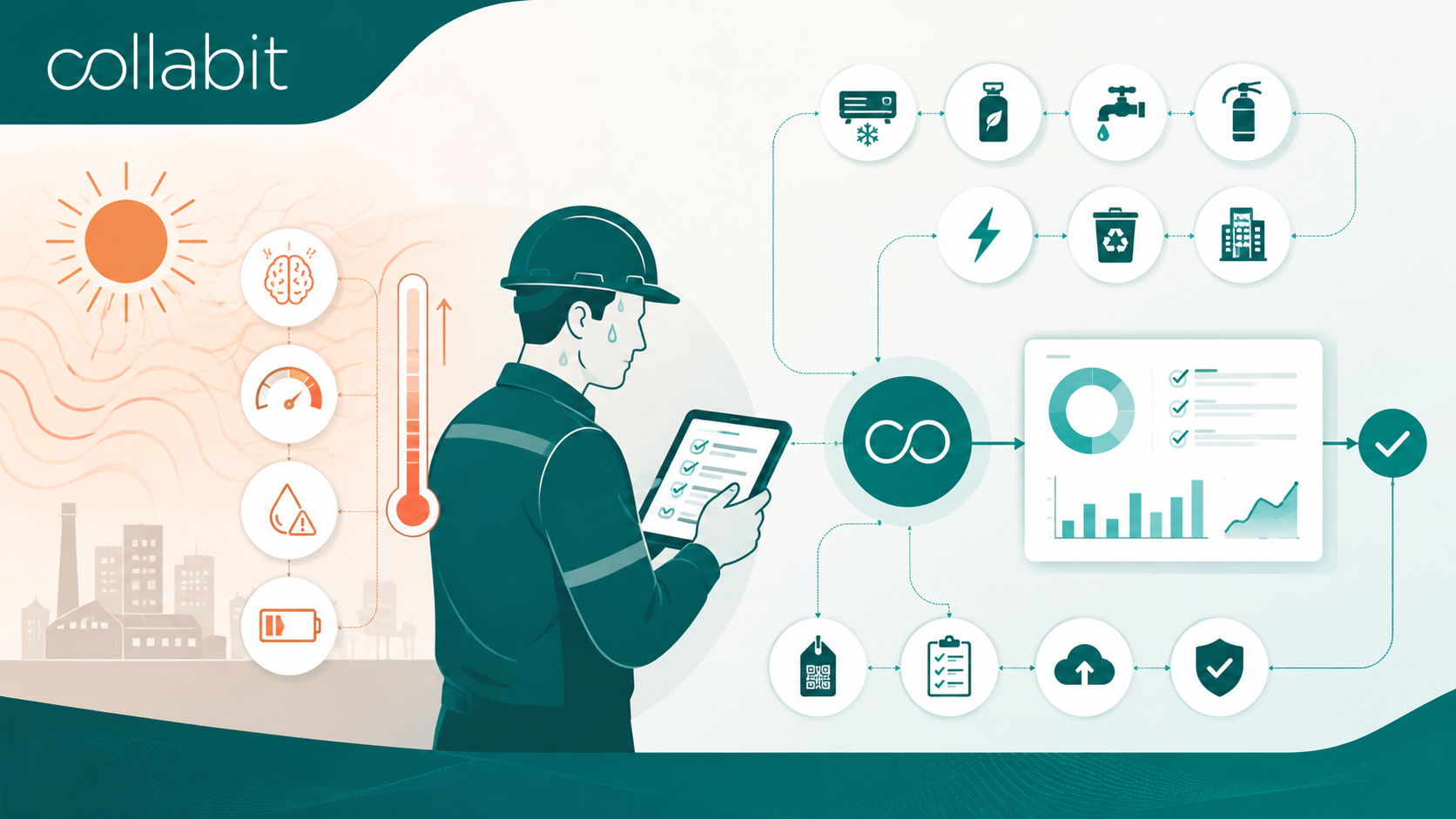
For HVAC and refrigeration teams, that means bringing regulated asset data, refrigerant movement, CO₂e visibility, job history, mobile workflows, barcode tagging, digital signatures and customer-ready evidence into one connected workflow.
The aim is not to create more admin.
It is to remove the gaps between the work being done and the evidence the business needs to prove it.
That matters because the HVAC industry is moving into a period where operational truth will become increasingly valuable.
Not just knowing that a job was completed.
Knowing what changed.
Knowing who completed it.
Knowing what gas moved.
Knowing whether the asset is still compliant.
Knowing whether the evidence can stand up when a customer, manager or auditor asks for it.
Final thought
The next phase of HVAC will not be defined only by equipment.
It will be defined by accountability.
As heating, cooling and refrigeration become more important to climate resilience and decarbonisation, the sector will need to manage more assets, more data and more evidence with greater precision.
That does not mean every business needs more complexity.
It means they need better control.
HVAC is becoming climate infrastructure.
And climate infrastructure needs more than maintenance.
It needs visibility, traceability and operational confidence.