Compliance is usually discussed as a process problem.
Was the form completed?
Was the asset updated?
Was the evidence captured?
Was the report submitted?
Was the job signed off?
But that misses something important.
Compliance is not completed by processes. It is completed by people.
And people do not perform the same way in every condition.
During hot weather, compliance-led sectors face a risk that is rarely discussed properly: the psychological and motivational pressure placed on the people responsible for keeping work accurate, evidenced and audit-ready.
For HVAC, water hygiene, fire safety, electrical, waste management and facilities management teams, summer is not just a busy period. It can be a period of reduced concentration, lower tolerance for admin, slower decision-making and greater operational friction.
That matters because compliance does not usually fail in one dramatic moment.
It fails through small gaps.
A missed photo.
A vague job note.
A delayed asset update.
A certificate uploaded later.
A checklist rushed at the end of a difficult job.
A planner making decisions from incomplete information.
Heat makes these small gaps more likely.
Not because people stop caring, but because heat changes the conditions under which people are expected to care.
Heat is a cognitive load problem
The physical risks of heat are well understood: dehydration, exhaustion, dizziness, heat illness and reduced stamina.
The cognitive effects are less visible.
A 2024 study on operators exposed to extreme hot and humid conditions found that once conditions rose above 35°C wet-bulb globe temperature, advanced cognitive functions were rapidly impaired. The affected functions included situation awareness, communication and working memory. The study also found more mistakes and reduced comprehension as temperature increased.
Those findings matter for compliance work because regulated field service is not just manual labour.
An engineer attending site has to understand the job, identify the correct asset, interpret previous history, complete the technical task, capture evidence, follow procedure, communicate with the customer and record what happened accurately.
A planner has to balance engineer availability, travel, skills, job duration, urgency and customer requirements.
A compliance manager has to detect gaps, review evidence, chase missing information and maintain confidence that the organisation can prove what happened.
All of that depends on working memory, judgement and attention.
Heat competes directly with those capabilities.
The productivity numbers are becoming difficult to ignore
The impact of heat is no longer a theoretical workplace concern.
The Lancet Countdown reported that extreme heat contributed to 639 billion lost labour hours globally in 2024. In the least developed countries, that loss was equivalent to 6% of GDP.
In Europe, Oxford Economics warned that a four-day heatwave could reduce quarterly labour productivity growth by 1.5 percentage points in the UK and up to two percentage points across western Europe. The same analysis noted that sectors unable to provide a protected working environment represent 27% of economic activity in the UK and 35% across western Europe.
Globally, the International Labour Organization has projected that heat stress could lead to the equivalent loss of 80 million full-time jobs by 2030. Agriculture and construction are expected to be among the most affected sectors, but the wider lesson applies to any work involving physical activity, site attendance, travel or exposed environments.
For compliance-led field service businesses, the headline risk is not only lost productivity.
It is lost accuracy.
A slower job can be rescheduled.
A missed compliance detail can become a future audit problem.
That distinction matters.
Heat affects motivation, not just output
Most businesses think about heat in terms of productivity: fewer jobs completed, longer travel days, more breaks, slower response times.
But motivation is just as important.
When people are hot, tired and uncomfortable, they become less willing to engage with tasks that feel repetitive, low-value or disconnected from the real work.
That is exactly where compliance admin is vulnerable.
If evidence capture feels like something added on after the job, motivation drops.
If the system is slow or clunky, patience drops.
If the engineer has to repeat information already held elsewhere, engagement drops.
If the planner is constantly correcting missing data, decision fatigue increases.
If the office team has to chase records after every job, compliance begins to feel like a burden rather than a control mechanism.
This is where the psychology becomes important.
People are more likely to complete tasks properly when the task feels clear, quick and meaningful. They are less likely to complete tasks well when it feels like unnecessary admin layered on top of a physically demanding day.
In a regulated sector, that is a serious operational issue.
The evidence from real-world worker data is clear
A major study using Australian mandatory workers’ compensation records from 1985 to 2020 found that high temperatures caused significantly more worker health claims, particularly among manual workers in outdoor-based industries. The study also found that the adverse effects had not reduced over time, with the largest effect seen in the 2015 to 2020 period.
This matters because it challenges the assumption that businesses naturally adapt to heat over time.
Experience helps, but it does not remove the risk.
In fact, the more normalised heat becomes, the greater the danger that businesses treat it as something teams should simply “get on with”.
That mindset is risky in compliance sectors.
If heat increases physical strain, cognitive load and the likelihood of worker health issues, then it also increases the chance that compliance tasks become inconsistent. The danger is not only that work slows down. The danger is that quality control becomes more dependent on individual resilience.
That is not a stable operating model.
The hidden issue is operational design
Heat exposes weak systems.
When conditions are comfortable and the workload is manageable, people can often compensate for poor processes. They remember where information is stored. They chase missing evidence. They double-check spreadsheets. They call someone who knows the site history. They manually rebuild the record.
But under heat, fatigue and pressure, those workarounds become harder to maintain.
That is when fragmented systems become more than an inconvenience.
They become a risk multiplier.
If job history sits in one place, asset records in another and evidence somewhere else, the business is asking people to carry complexity in their heads.
If engineers have to manually identify assets, search for past records and remember which evidence is required, the system is relying on perfect attention at the exact moment attention may be reduced.
If planners have to build schedules around incomplete durations, missing skills or unclear locations, the business is relying on human judgement to correct poor data under pressure.
If compliance records are completed after the job rather than during it, the business is relying on memory.
Heat makes all of that less reliable.
Compliance fatigue is not laziness
There is a phrase that needs to be taken more seriously in compliance-led sectors: compliance fatigue.
It is not laziness.
It is not carelessness.
It is not a lack of professionalism.
It is what happens when people are asked to repeatedly complete detailed, high-accountability tasks through systems that make the work harder than it needs to be.
Heat intensifies that fatigue.
It makes small admin tasks feel heavier.
It makes unclear instructions more frustrating.
It makes duplicated data entry more irritating.
It makes late evidence capture less reliable.
It makes manual scheduling more mentally draining.
The result is not always a major failure.
More often, it is a gradual decline in record quality.
That is what makes it dangerous.
Why this matters across compliance sectors
The issue applies differently across each sector, but the pattern is the same.
In HVAC and F-Gas, engineers may be working in plant rooms, roof spaces or exposed sites while still needing to capture refrigerant movement, asset history, leak-check evidence, signatures and CO₂e-related information.
In water hygiene, field teams may be moving between sites, taking readings, completing sampling work, documenting remedials and maintaining evidence that could later become critical for dutyholder confidence.
In fire safety, the quality of inspection records, remedial actions and asset evidence matters because the consequences of ambiguity are high.
In electrical, certification, test results, asset records and follow-up actions need to be accurate and traceable.
In waste management, transfer documentation, service activity, customer records and operational evidence need to move quickly and cleanly between the field and office.
In facilities management, reactive pressure, planned maintenance, contractor visibility and customer expectations all increase when heat creates building performance issues.
The work differs.
The psychological pattern does not.
When conditions become harder, systems need to make accuracy easier.
Heat changes the meaning of efficiency
Efficiency is often sold as speed.
That is too narrow.
In compliance sectors, efficiency should mean reducing the mental effort required to do the right thing correctly.
That means fewer duplicate entries.
Clearer job instructions.
Better access to asset history.
Evidence captured at the point of work.
Digital signatures collected on site.
Photos, notes and documents attached to the correct job and asset.
Dashboards that show what needs attention.
Reports that do not have to be rebuilt manually.
Schedules that account for skills, locations, realistic durations and customer requirements.
This is not just about getting more jobs done.
It is about protecting decision quality when people are under pressure.
Where Collabit fits
Collabit is built around a simple operational principle: compliance should not depend on scattered systems, manual reconstruction or individual memory.
For compliance-led teams, that matters all year round. During hot, high-pressure periods, it matters even more.
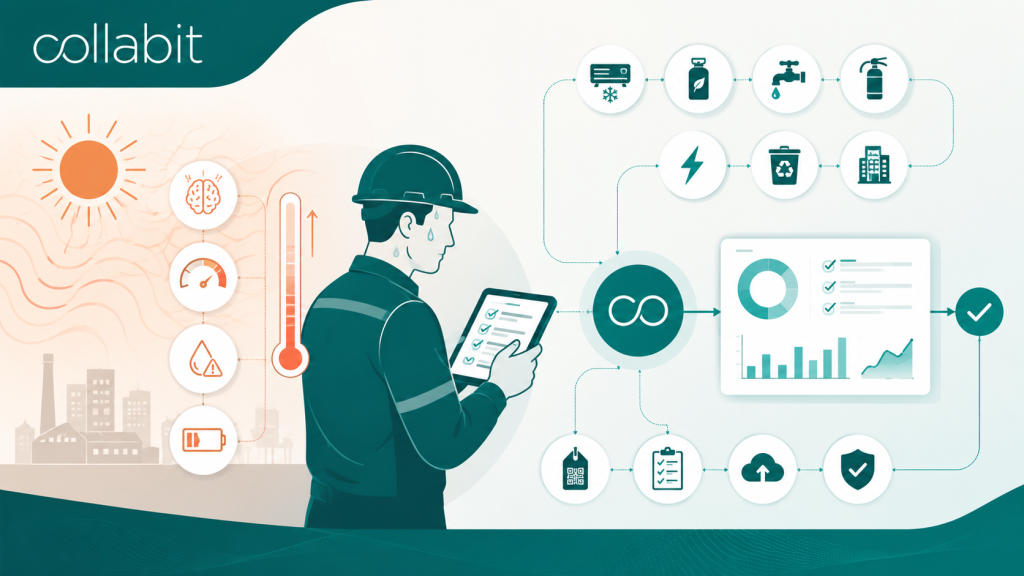
Collabit brings jobs, assets, engineers, customers, compliance records, reporting and invoicing into one connected platform. That gives teams one source of truth rather than multiple places to check, update and reconcile.
For engineers, mobile workflows and asset tagging help reduce ambiguity on site. Barcode and QR-enabled asset identification make it easier to access the right record quickly, while structured workflows help ensure required evidence is captured as part of the job rather than chased later.
For office teams, dashboards and reports reduce the need to manually stitch together information from spreadsheets, emails and job notes. That matters when teams are already dealing with urgent summer demand, customer queries and operational disruption.
For planners, Collabit AI Planner supports automated period planning, preflight data validation, skills-aware assignment, multi-technician scheduling, asset-based duration repair, interactive rescheduling, optimisation KPIs and a full audit trail. That means planning decisions are not just faster. They are easier to trust.
The point is not that software removes heat.
It does not.
The point is that better systems reduce the cognitive load required to keep work accurate when conditions become harder.
The leadership question
Hot weather is usually treated as a health and safety issue.
It is also a management issue.
It forces leaders to ask whether their operating model is designed around real human behaviour or ideal human performance.
Because ideal performance assumes people are always alert, comfortable, motivated, patient and able to remember every detail.
Real performance is different.
People get tired.
People get hot.
People get interrupted.
People prioritise what feels urgent.
People avoid admin that feels disconnected from value.
People make more mistakes when the system asks too much of them.
Good operational design recognises that.
It does not blame people for being human. It reduces the unnecessary burden placed on them.
Final thought
Heat does not create every compliance problem.
It reveals the ones already there.
If evidence capture depends on memory, heat will expose it.
If asset records are hard to access, heat will expose it.
If reporting depends on spreadsheets, heat will expose it.
If scheduling depends on manual correction, heat will expose it.
If compliance feels like extra admin, heat will expose it.
The businesses that adapt best will be those that understand compliance as a human system, not just a regulatory one.
People need clarity.
Teams need visibility.
Managers need evidence.
Customers need confidence.
And when conditions become harder, the system should make compliance easier, not heavier.