When compliance lives in five places, nobody owns it
The most expensive refrigerant leak in an HVAC or refrigeration operation is not always the one that escapes into the atmosphere. Increasingly, it is the leak in the information system: the missing asset record, the expired certificate buried in an inbox, the engineer qualification nobody checked, the spreadsheet formula nobody noticed, the audit trail that exists in theory but not in a form anyone can retrieve under pressure. In other words, the real competitor in this market is not a named software brand. It is fragmentation.
That matters because UK F-gas compliance is now too operationally demanding to be managed as an administrative afterthought. Great Britain’s current guidance requires leak checks on stationary refrigeration, stationary air conditioning, heat pumps, fire protection equipment, refrigerated trucks and trailers, electrical switchgear and organic Rankine cycles. The trigger points are framed in CO2e, not simply kilograms of refrigerant: 5 tonnes CO2e starts the obligation, 50 tonnes increases frequency, and 500 tonnes triggers the highest scrutiny and, in many cases, automatic leak detection. If a leak is found, it must be repaired as soon as possible and the repair must be rechecked within a month.
Those duties are not just environmental. They reshape operations. An operator cannot meet them reliably without knowing, at asset level, what refrigerant is in each system, what charge size it contains, what its CO2e equivalent is, when the next leak test is due, whether automatic leak detection is installed, who last serviced it, what gas was added or recovered, and whether the person doing the work was properly qualified. That is not “paperwork around the job”. It is part of the job.
The record-keeping duty makes this even clearer. For relevant equipment containing 5 tonnes CO2e or more, operators must keep five years of records covering the quantity and type of gas at installation, gas added during maintenance, dates and results of mandatory leak checks, and recovery and disposal actions. They must also keep details of the companies used to install, service or decommission the equipment. This is a classic data-governance requirement: the regulation assumes traceability over time, across people, sites and interventions.
Certification works the same way. Individuals need the correct F-gas qualifications for the activities they undertake. In RACHP systems alone, the regime distinguishes between category 1, 2, 3 and 4 certificates depending on what the engineer is doing and whether the refrigeration circuit is opened. Companies that service stationary equipment operated by others must also be certified, must demonstrate that they employ enough trained staff, and must renew certification every three years.
This is why fragmented legacy operating models are now more than inefficient: they are non-aligned with the logic of the law. In many businesses, one system “knows” the asset, another “knows” the job, a shared drive “knows” the certificates, and an engineer’s competency record sits somewhere else again. The business then relies on people to stitch them together manually whenever a service event, customer query or inspection occurs. Unsurprisingly, manual stitching is error-prone. In a field study of operational spreadsheets, researchers found errors in around 0.8% to 1.8% of formula cells. That sounds small until one remembers that a compliance process built on several spreadsheets, copied across multiple sites and updated over years, multiplies the surface area for failure.
The hidden cost is not just the occasional mistake. It is the continuous tax on attention. When the system is fragmented, skilled engineers and operations managers become human middleware: checking asset registers against service notes, confirming whether a certificate is still valid, recalculating intervals after a refrigerant change, chasing evidence before an audit, reconstructing a maintenance history from disconnected systems. None of that improves system performance or customer outcomes. It simply compensates for weak process architecture. The point is philosophical as much as practical: a business should not need heroic memory to stay compliant. It should need good systems.
The timing is awkward for anyone still relying on heroic memory, because regulation is tightening while technical labour is constrained. The UK’s wider engineering labour market remains under pressure. The 2024 Employer Skills Survey showed 250,500 skills-shortage vacancies across the economy, and civil engineering shortages rose by 84% between 2022 and 2024. In parallel, decarbonisation is increasing demand for adjacent competencies: Nesta reported that only around 3,000 heat-pump installers were active, while the UK would need 4,000 to 6,000 new installers trained each year to meet 2030 goals, and about 30% of installers cited difficulty finding adequately skilled staff. Even where representation is improving, the talent pool is still narrow: women held 16.9% of UK engineering roles in 2025.
In that environment, the question is no longer whether digitalisation is desirable. It is whether the organisation is using scarce, expensive technical labour in the right place. The intellectually serious answer is that engineers should spend more time diagnosing systems, improving reliability and reducing emissions, and less time reconstructing evidence trails that a well-designed platform could have captured once, correctly, at source.
This is where an integrated Collabit-style workflow becomes strategically relevant. An asset register gives the operator a single source of truth for refrigerant type, charge and CO2e threshold. Automated scheduling converts regulation into calendar discipline, so leak checks happen because the system knows the obligation instead of a planner remembering it. Digital certification storage and engineer competency tracking connect the “who” to the “what”, so only correctly qualified people are assigned and auditable proof is available instantly. Audit trails and mobile field access mean intervention data is captured once, in the field, instead of rekeyed later. Reporting dashboards turn compliance from a rear-view mirror into operational intelligence: overdue leak checks, upcoming certificate renewals, high-loss assets, refrigerant trends, and recurring failure patterns become visible. Integrations and APIs matter because they remove duplication between field service, HR, finance, and customer systems; that is how you reduce spreadsheet risk rather than simply exporting it faster.
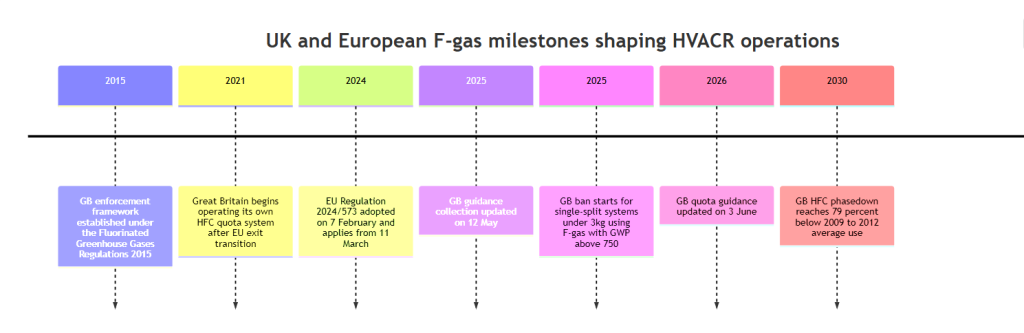
There is also a market signal that operators should not ignore. In Great Britain, official guidance confirms that HFCs are being phased down by 79% by 2030 from the 2009–2012 average, quota is required for producing or importing bulk HFCs, and importing above quota can trigger a penalty equal to 200% of the excess from the next allocation. Current GB guidance also confirms that “single split” systems containing less than 3 kg of refrigerant are banned from 2025 if they use an F-gas with GWP above 750, alongside other existing equipment bans. Meanwhile, the EU’s recast F-gas Regulation was adopted on 7 February 2024 and started applying on 11 March 2024, with a steeper quota system, more digital enforcement, and an explicit trajectory toward HFC phase-out by 2050. Great Britain is not identical to the EU regime, but the direction of travel is unmistakable, especially for firms with Northern Ireland or EU-facing exposure.
The deeper point is this: regulation is quietly selecting for a new kind of operator. Not just one that uses lower-GWP refrigerants, but one that treats compliance as a data architecture problem. The winners will not be the companies with the loudest sustainability messaging. They will be the ones that can answer basic questions instantly and accurately: What refrigerant is in that asset? Is it still serviceable under current rules? When is the next mandatory leak check? Who touched it last? Were they qualified? What was added? What was recovered? What is our exposure if quotas tighten again? When those answers exist in one place, compliance becomes governable. When they do not, complexity becomes the business model.
And that is the uncomfortable conversation HVAC and refrigeration leaders should now be having: are we really managing refrigerant risk, or are we merely managing the appearance of control?