Last updated: 18th March, 2026
In most organisations, system decisions are framed around efficiency, cost, and scalability.
But there’s a quieter impact that rarely gets discussed.
What fragmented systems do to the people using them every day.
If your team is moving between multiple platforms just to complete a single job, they’re not just losing time. They’re experiencing something psychologists have studied for years.
Cognitive load.
Cognitive Load Theory, developed by John Sweller, explains that our working memory has a limited capacity. When people are forced to juggle multiple sources of information, remember where data lives, and constantly switch context, that capacity gets overwhelmed.
This is exactly what fragmented systems create.
Instead of focusing on the task itself, employees are using mental energy to navigate the system around the task.
And that has consequences.
Research from Sophie Leroy on “attention residue” shows that when we switch between tasks, part of our attention stays behind on the previous one. So when an engineer jumps between job sheets, emails, compliance platforms, and reporting tools, they’re never fully present in any one place.
It feels like low level distraction. But over time, it compounds.
Then there’s decision fatigue.
Roy Baumeister’s work highlights how the quality of decisions deteriorates after long periods of decision making. In a fragmented environment, even simple actions require micro decisions.
Where is the latest version?
Is this the correct data?
Do I trust this system or that one?
These aren’t big decisions. But they add up, quietly draining focus and confidence throughout the day.
And when people don’t trust the systems they rely on, something else happens.
They create workarounds.
Shadow processes.
Personal notes.
Double entry “just to be safe.”
From a management perspective, it looks like inefficiency.
From a human perspective, it’s a coping mechanism.
The Job Demands-Resources model in organisational psychology explains this well. When job demands increase such as complexity, admin, and mental effort without the right resources to support them, stress rises and engagement falls.
Disconnected systems increase demands.
Connected systems act as a resource.
This is why the impact of better systems is often underestimated.
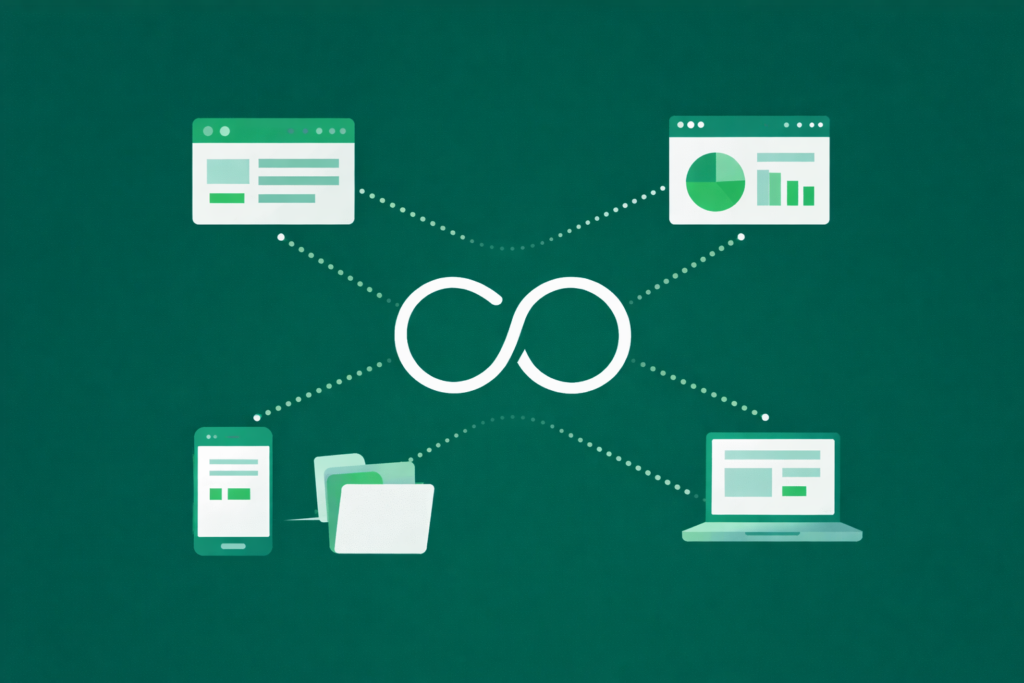
When everything connects, the change isn’t just operational.
Cognitive load drops because people aren’t holding everything in their head.
Attention improves because there’s less switching.
Confidence returns because there’s one clear source of truth.
And perhaps most importantly, people can focus on the job they were actually hired to do.
In industries like HVAC and water hygiene, where compliance, accuracy, and speed matter, this isn’t a nice to have. It directly affects performance, risk, and morale.
We often talk about digital transformation as a way to improve output.
But the real shift is simpler than that.
It’s about reducing the mental weight people carry at work.
Because when systems don’t talk, people pick up the slack.
And when they do, work starts to feel the way it should again.
Published by: Elle Sherwood
Marketing Director