
By Joanna
If you work in electrical contracting, the real regulations story in 2026 is not simply that the Wiring Regulations have changed again.
It is that the distance between doing compliant work and proving compliant work is getting bigger.
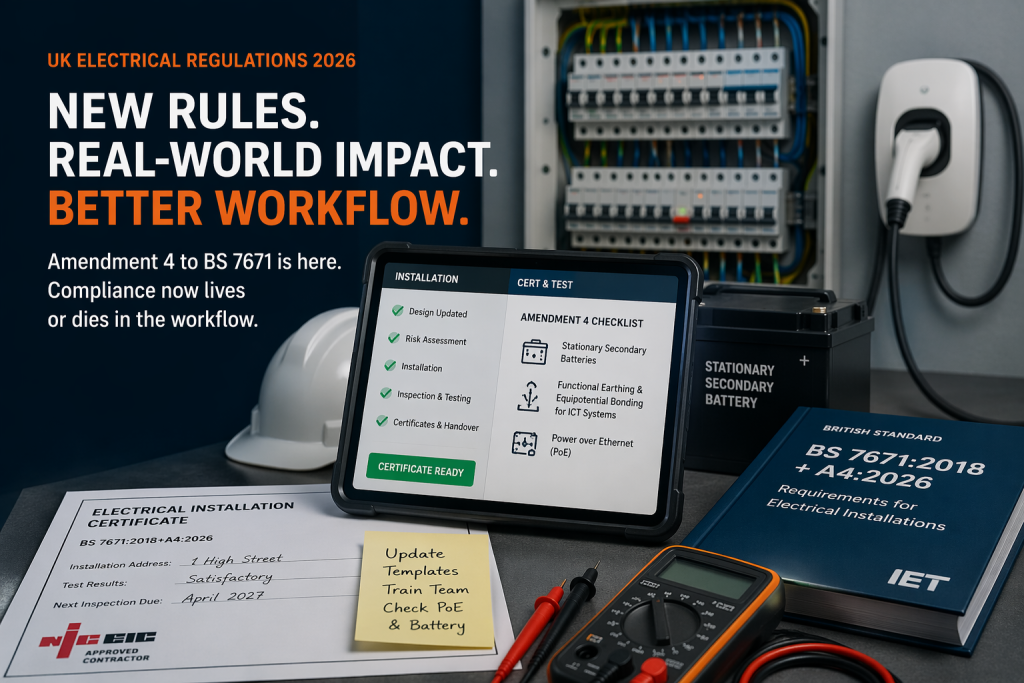
On 15 April 2026, IET and BSI published BS 7671:2018+A4:2026, better known as 18th Edition Amendment 4. It can be used immediately, and the previous version remains current only until 15 October 2026.
That sounds like a transition period.
In practice, it feels more like a countdown.
Because most contractors will hear about Amendment 4 quickly enough. The harder part is making sure the work on site, the engineer notes, the test results, the certificates, the remedials and the final handover all line up cleanly enough to show the business is genuinely in control.
That is why the most important compliance question in 2026 is not just:
“What changed in the regs?”
It is:
“Can our workflow keep up?”
Amendment 4 reflects where the industry is heading
Amendment 4 is not a cosmetic update. It reflects what electrical work now looks like on the ground: more electrification, more connected systems, more digital infrastructure, more energy storage, and more complexity across installations.
The update introduces a new chapter on stationary secondary batteries, a new section covering functional earthing and functional equipotential bonding for ICT equipment and systems, and a new section on Power over Ethernet. There are also broader updates across the standard as installation practice continues to evolve.
That matters for one simple reason.
The more detailed the standard becomes, the less room there is for messy processes.
Technical competence still comes first. Software does not replace that.
But when the work becomes more complex, scattered evidence becomes more dangerous.
Where compliance starts to unravel
In practice, electrical businesses rarely run into difficulty because nobody did any work.
They come unstuck because the evidence is fragmented.
A survey is completed, but the asset information is incomplete.
A test is carried out, but the result ends up buried in a PDF nobody can find six months later.
An engineer spots a remedial, but it never becomes a tracked next action.
A certificate is produced, but it is not clearly tied to the right site, right asset, right job and right version of the work.
A manager knows the team is overloaded, but cannot easily see which jobs are still waiting on documentation, which need a return visit, and which would become a problem the moment a customer asks questions.
That is when a standards update stops being a technical matter and starts becoming a commercial one.
Not just because of compliance risk, but because rework, admin chasing, missing attachments and poor visibility all drain time and margin.
Amendment 4 makes information discipline more important, not less
The first response to Amendment 4 should absolutely be technical familiarisation.
Teams need to understand what is new, what has changed, and how that affects design, installation, inspection, testing and certification.
But that is only half the job.
The second question is just as important:
How will the business capture, connect and retain the right information from first visit to final record?
That matters whether you are dealing with battery-related work, digital infrastructure, inspection and testing, or day-to-day installation and remedials.
Because compliance is not proved by good intentions.
It is proved by records.
And the stronger the workflow, the easier it is to create those records naturally as the job moves forward, instead of trying to rebuild them later under pressure.
What better workflow actually looks like
For me, the practical response to regulatory change starts with structure.
Every job should sit inside a clear site and asset context.
Every engineer should be able to record findings in a consistent way.
Every certificate, test result and attachment should be tied to the right piece of work.
Every remedial should become a visible next action, not remain trapped in someone’s notes.
Every manager should be able to see what is complete, what is outstanding, and where the real compliance risk sits.
That may not sound dramatic.
But it is often the difference between a business that feels in control and one that feels permanently reactive.
It also improves the customer experience.
When a client asks for a certificate, the history of work at a site, confirmation of testing, or evidence that a recommendation has been actioned, the answer should not depend on who happens to be in the office that day.
It should already be part of how the business runs.
This is not “just paperwork”
One of the biggest mistakes I see is treating documentation as admin that happens after the important work is done.
But in reality, documentation is how compliant work becomes visible, transferable and manageable.
It is how a supervisor sees what an engineer found.
It is how the office turns site activity into a clean customer record.
It is how a business proves consistency across multiple engineers and multiple jobs.
It is how you stop having the same conversation twice because the last visit was never properly recorded.
So when Amendment 4 arrives, the question is not only whether your electricians have read the update.
It is whether your business process is strong enough to support the standard you are trying to work to.
What electrical contractors should be doing now
If I were setting priorities for the rest of 2026, they would be straightforward.
First, get the team up to speed on Amendment 4 and the areas of work it affects.
Second, review your certificates, forms, test records and handover documents so they still support the way you now need to work.
Third, make sure remedials, follow-ups and supporting attachments are captured as part of the workflow, not left to drift into admin limbo.
Fourth, give managers better visibility so they can see not just scheduled work, but documentation status, outstanding actions and site history.
And finally, use this change as an excuse to tighten the whole operational chain — from survey to job to certificate to follow-up.
Because that is where compliance succeeds or fails.
At Collabit, that is where we believe software should help most. Not as another disconnected admin layer, but as the system that connects jobs, asset history, engineer records, documents and follow-up in one place.
Because in 2026, compliance in electrical contracting does not live or die in the handbook alone.
It lives or dies in the workflow.